


Deep Time: Walking on 550 Million Years of Civilisational Memory

By Yash Jegathesan, Founder, Yash Foundation
Part 6 of the Soul Return: Land and Memory - Civilisational Transmission Series
When we think about history, we usually begin with people.
We remember kingdoms, temples, monuments, trade routes and the remarkable achievements of past civilisations. Archaeology allows us to uncover fragments of these stories, while oral traditions and sacred texts help preserve collective memory.
But what if history begins much earlier?
Long before the first settlements appeared in Southeast Asia, before merchants sailed across the Indian Ocean, and before the temples of Bujang Valley were built, the Earth itself had already been writing a story that stretched across hundreds of millions of years.
Civilisations remember through monuments, stories and rituals.
The Earth remembers through stone.
Looking Beyond Human History
One of the most profound realisations during the Soul Return retreat at Bujang Valley was that heritage does not begin with archaeology.
It begins with geology.
The rocks beneath our feet are far older than any civilisation. In fact, some of the rock formations surrounding Bujang Valley date back more than 550 million years, making them among the oldest geological formations preserved in Peninsular Malaysia.
That means the landscape supporting one of Southeast Asia's earliest civilisations had already existed for an almost unimaginable span of time before people ever settled there.
This changes how we understand heritage.
Rather than seeing temples and archaeological sites as isolated monuments, we begin to recognise them as chapters built upon an ancient landscape that shaped where people travelled, traded, settled and worshipped.
When Geology Becomes Civilisation
Malaysia preserves an extraordinary geological story.
The ancient rocks surrounding Bujang Valley tell one chapter.
The Klang Gates Quartz Ridge, often described as the world's longest quartz ridge, represents another chapter formed around 200 million years ago.
Running through the centre of Peninsular Malaysia, the Titiwangsa Range, the backbone of the peninsula, records hundreds of millions of years of tectonic activity that shaped rivers, ecosystems and movement across the land.
Viewed separately, these are geological landmarks.
Viewed together, they become the foundation upon which civilisation emerged.
Over immense periods of time:
Geology became geography.
Geography shaped ecology.
Ecology influenced settlement.
Settlement gave rise to civilisation.
Civilisation created culture, ritual, architecture and identity.
Heritage therefore begins much earlier than the monuments we preserve.
It begins with the Earth itself.
Walking on Ancient Ground
During the Soul Return retreat, one of the most memorable moments happened away from museums and archaeological remains.
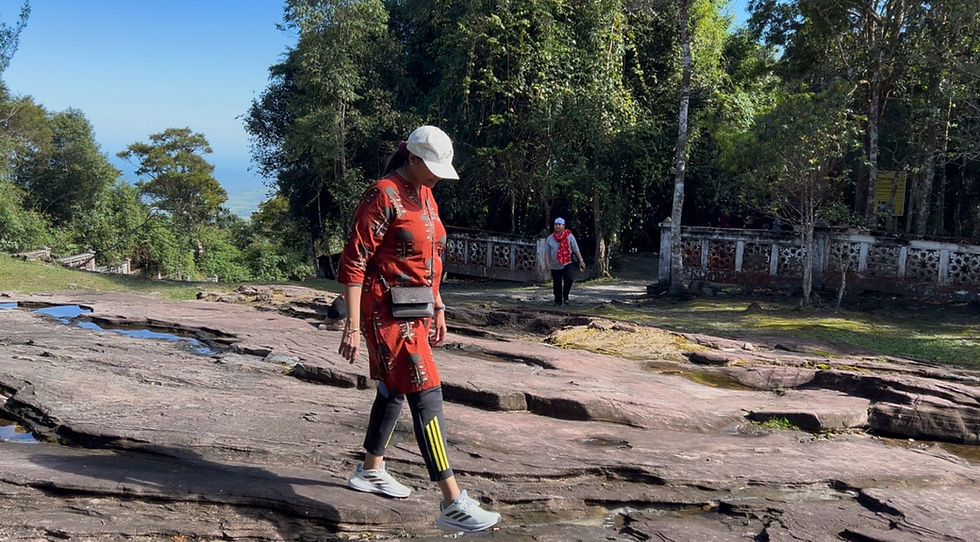
Participants simply stood on exposed rock.
At first glance, nothing seemed extraordinary.
There were no dramatic cliffs or spectacular formations.
But once everyone understood that the rocks beneath their feet had endured for more than half a billion years, something shifted.
People became quieter.
The landscape felt different.
A simple question emerged:
How often do we stop and think about the age of the ground beneath us?
That moment transformed geology from an academic subject into a lived experience.
Standing on ancient ground changes our perception of time.
Human history, remarkable as it is, occupies only a brief moment within the Earth's much longer story.
Entire civilisations rise and fall in what is, geologically speaking, only an instant.
The Landscape Shapes the Story
Ancient landscapes are not passive backgrounds waiting for history to unfold.
They actively shape civilisation.
Mountain ranges influence migration.
Rivers sustain agriculture.
Coastlines connect distant cultures.
Natural landmarks become navigational guides.
For centuries, Mount Jerai served as a prominent landmark for sailors approaching the Malay Peninsula, quietly directing maritime movement long before modern navigation existed.
The land itself influenced where people gathered, traded, built communities and established sacred places.
This relationship reminds us that natural heritage and cultural heritage cannot be separated.
Every temple stands within a landscape.
Every civilisation grows from an environment.
Every story begins somewhere on the Earth.
Heritage Through Deep Time
This understanding has gradually shaped the work of the Yash Foundation and the Soul Return Project.
Rather than approaching sacred landscapes only as archaeological destinations or places of pilgrimage, we see them as living classrooms where geology, archaeology, ecology, history and personal reflection intersect.
Walking through these landscapes becomes more than sightseeing.
It becomes an invitation to experience time differently.
To recognise that we are participants in a story that began long before us and will continue long after us.
Before There Were Temples
Perhaps this is one of the greatest lessons that deep time offers.
Before there were kingdoms, there was landscape.
Before there were temples, there was stone.
Before memory became story, the Earth was already remembering.
If civilisation is to endure into the future, perhaps our responsibility is not only to preserve monuments and traditions, but also to protect the ancient landscapes that made those civilisations possible.
Because every civilisation ultimately stands upon the memory of the Earth.
Continue the Soul Return: Land and Memory - Civilisational Transmission Series
Each article explores how landscapes preserve memory across geology, archaeology, culture and lived experience, inviting us to see heritage not as isolated monuments but as an interconnected story stretching from deep geological time to the present day.
About the Author
Yasotha (Yash) Jegathesan is the founder of the Yash Foundation and creator of the Master Your Heritage Living™ (MYHL™) framework. Through the Soul Return Project, she explores the relationship between sacred landscapes, cultural memory, civilisation and individual transformation, bringing together geology, archaeology, history and lived experience into a true approach to heritage education.


Comments